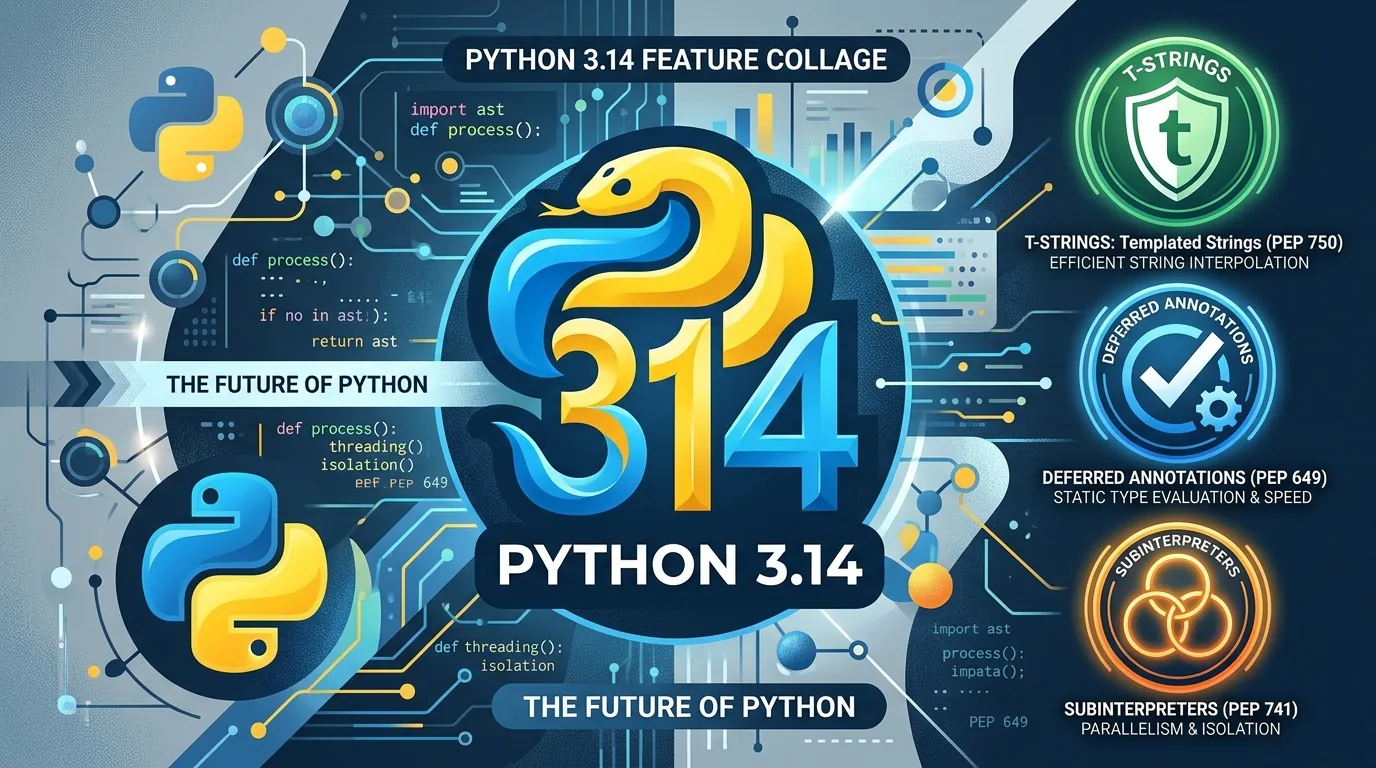
Python 3.14 isn’t just another incremental release — it fundamentally rewrites how we handle annotations, strings, and concurrency. Here’s what you need to know about the three game-changers that landed in October 2025.
1. A New Era for Python — What’s Actually Different This Time?
Let’s be honest: every new Python version promises “significant improvements,” and half the time you’re left squinting at changelogs wondering if anything actually changed. But 3.14? This one hits different.
I’ve been using Python for over a decade, and I can safely say that the trio of features landing in this release — deferred annotations, template strings, and standard-library subinterpreters — aren’t just nice-to-haves. They solve real, painful problems that have haunted large-scale Python projects for years. We’re talking about startup-time bloat, SQL injection nightmares, and the GIL’s stranglehold on parallelism.
Sure, there’s also the freethreaded mode (finally official!), a shiny new JIT for Windows and macOS, and a bunch of asyncio introspection goodies. But the three features I’m diving into today are the ones that’ll change how you write Python, not just how fast it runs.
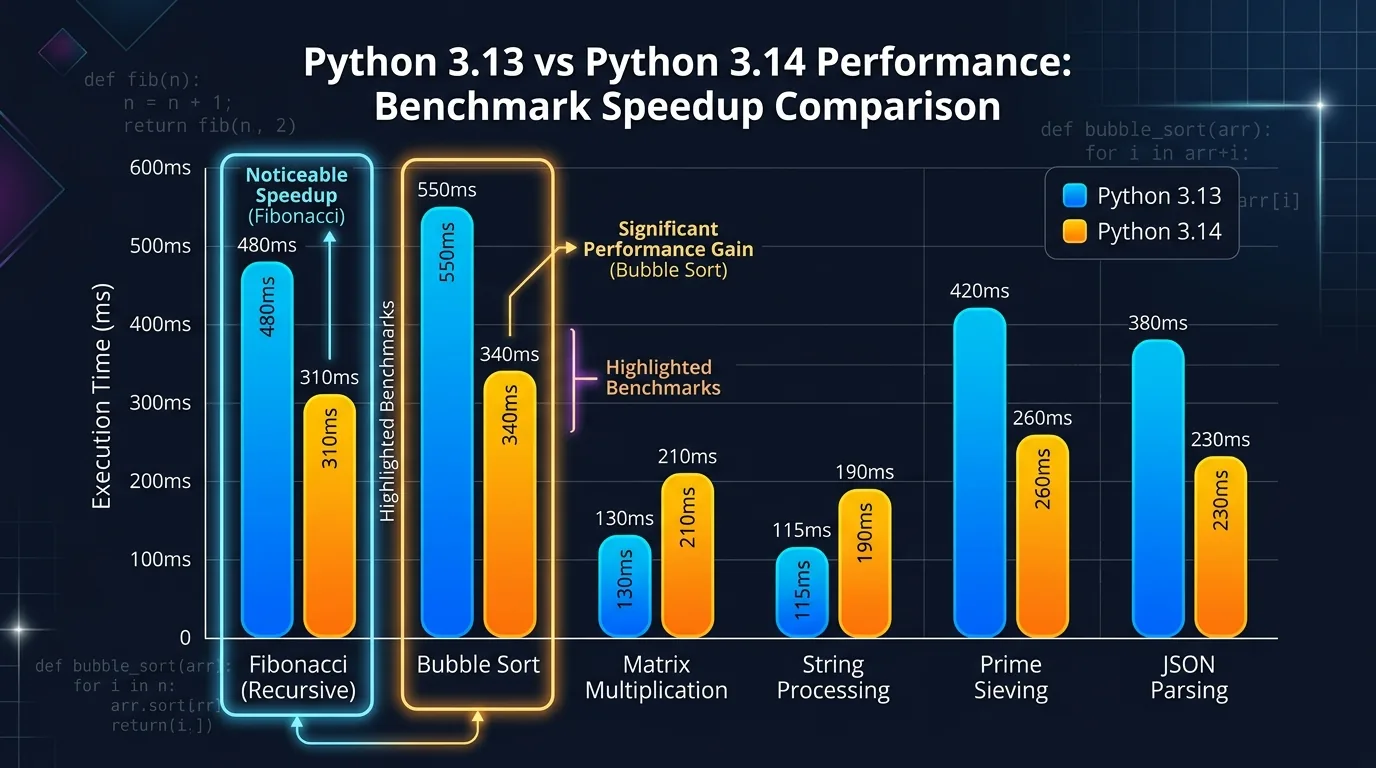
But here’s the kicker: software engineer Miguel Grinberg ran some benchmarks and found Python 3.14 is about 27% faster than 3.13 on a single-threaded Fibonacci test. That’s not a typo. And he’s not alone — the numbers are real. Of course, real-world code won’t always see that boost, but it’s a sign that the core team is finally making performance a first-class citizen.
2. Deferred Annotations: Goodbye to "ForwardRef" String Warts
Alright, hands up if you’ve ever written this:
def process(data: "SomeType") -> "AnotherType": ...
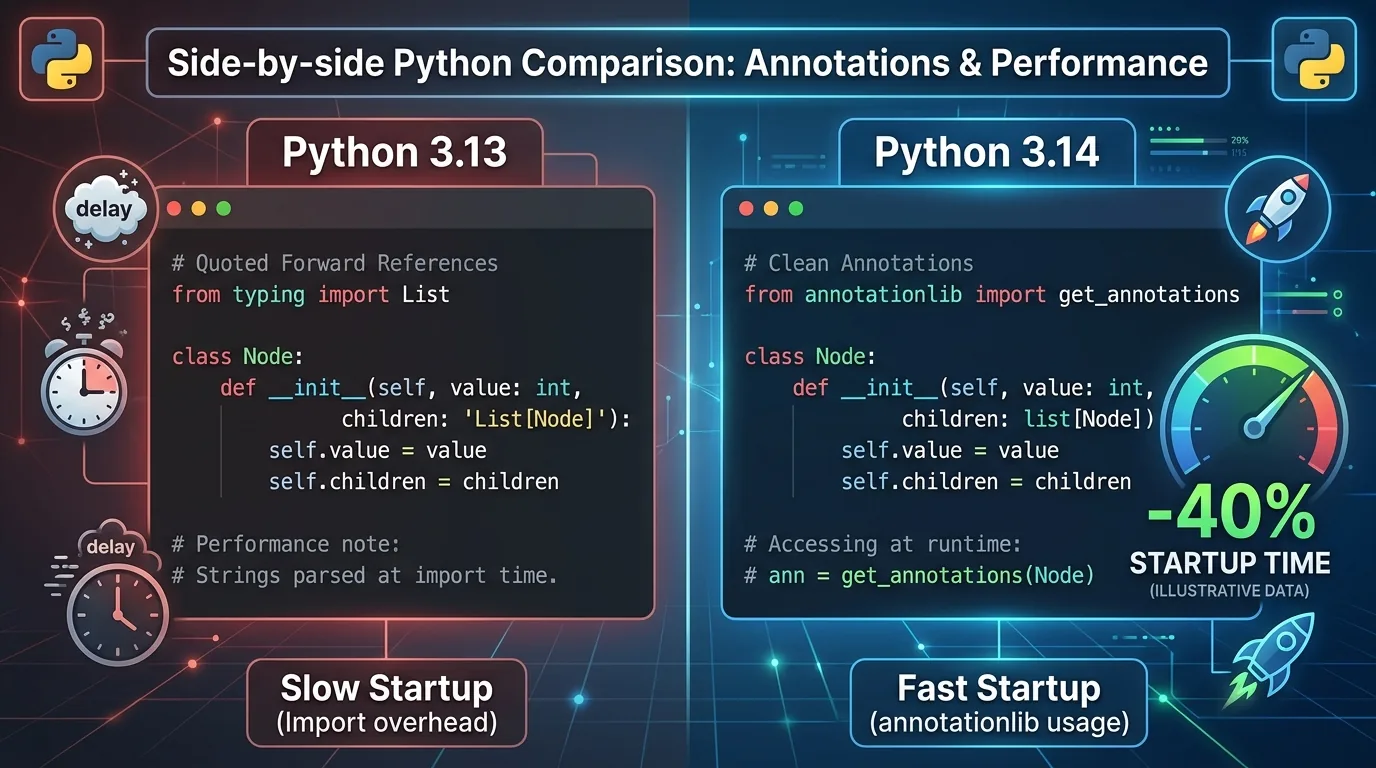
You know, that ugly string wrapping because the type wasn’t defined yet at the point of annotation? Or worse, the startup times where huge codebases spent ten seconds just parsing Optional[List[...]] that nobody ever introspects? I’ve been there. It’s awful.
Python 3.14 kills that nonsense with PEP 649 and PEP 749. Starting now, annotations on functions, classes, and modules are not evaluated immediately. Instead, they’re stored in a special “annotation function” that only gets called when you actually ask for them. Think of it as lazy evaluation for your type hints.
The benefits are immediate and substantial:
- Startup time plummets. That massive Django or FastAPI project that took five seconds to import? Now it might take three. The runtime cost of defining annotations is nearly zero.
- Forward references work without quotes. Because the annotation isn’t evaluated at definition time, you can just write
arg: Undefinedand the type checker will figure it out later. No more messy strings. - A new
annotationlibmodule gives you fine-grained control over how annotations are introspected. You can request them inVALUEformat (evaluate normally),FORWARDREFformat (returnForwardRefobjects for undefined names), orSTRINGformat (raw source text).
Here’s a quick taste — notice how it handles an undefined name:
from annotationlib import get_annotations, Format

def func(arg: Undefined):
    pass

# This would raise NameError in 3.13
print(get_annotations(func, format=Format.FORWARDREF))
# Output: {'arg': ForwardRef('Undefined', owner=<function func at ...>)}
That’s massive for type-checking tools and runtime reflection. No more crashing because you referenced a type from a module that hasn’t loaded yet.
Now, does this break anything? The core team has been careful. In most cases, existing code works unchanged. But if you’re doing something pathological — like executing annotations at import time for metaprogramming — you might need to switch to annotationlib explicitly. The Porting to Python 3.14 guide covers the edge cases. It’s not a sea change, but it’s a relief for every developer who’s ever stared at a NameError that only appeared at runtime.
3. Template Strings (t-strings): When f-strings Aren’t Safe Enough
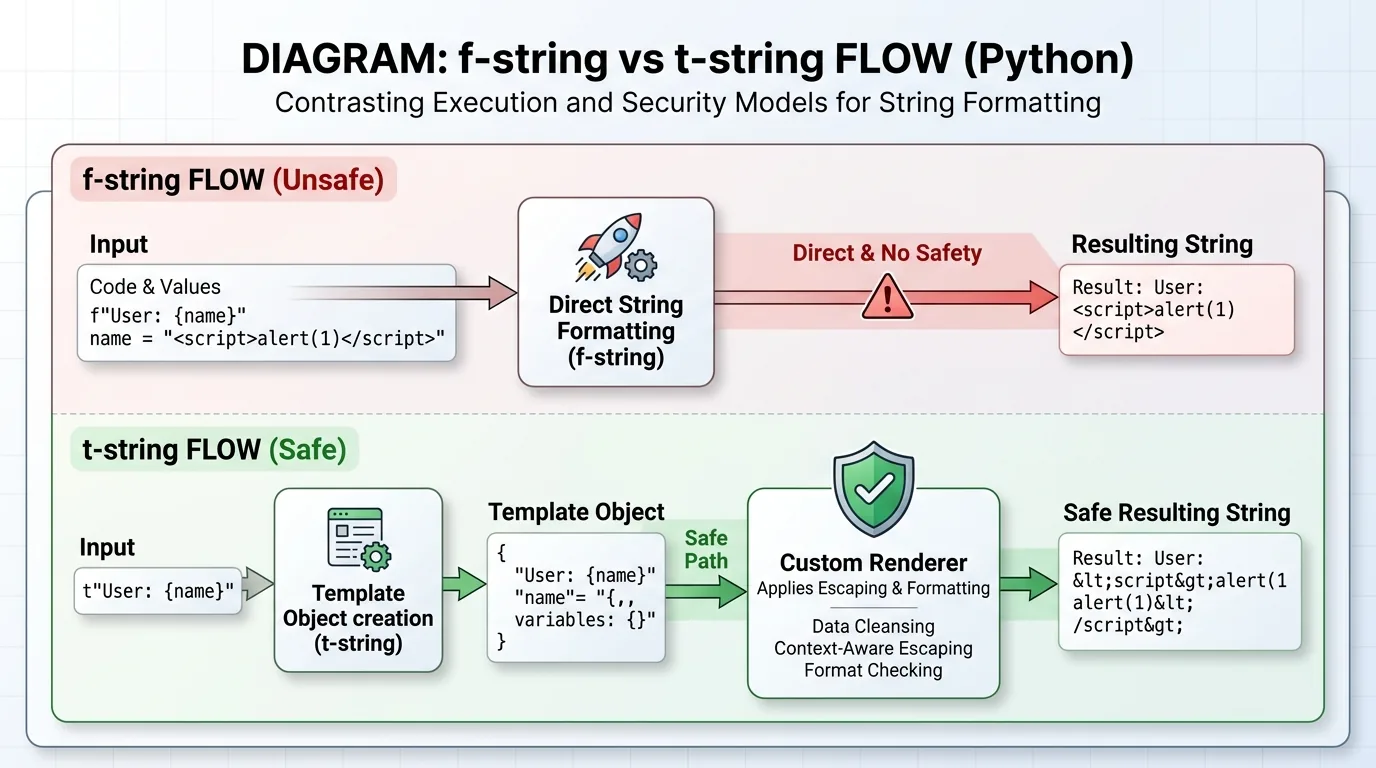
f-strings are great. I use them every day. But they have a dirty secret: they evaluate expressions immediately and produce a string, giving you zero control over what happens after. If you’re building HTML, SQL, or any other structured output, that’s a recipe for injection attacks.
Python 3.14 introduces template strings — or t-strings — via PEP 750. The syntax is identical to f-strings except you use t instead of f:
name = "World"
t_string = t"Hello, {name}!"
But here’s the twist: t_string is not a string. It’s a Template object that remembers both the literal parts and the interpolated expressions. You can then decide how to render those pieces — safely.
Think of it as separating data from presentation, but at the syntax level. Need to generate SQL? Use a t-string with a custom SQL renderer that properly escapes values. HTML? Same thing. The template captures the structure; the rendering logic handles sanitization.
from html import escape
def render_html(template: Template) -> str:
result = []
for literal, value in template.parts():
result.append(literal)
if value is not None:
# Escape the value to prevent XSS
result.append(escape(str(value)))
return ''.join(result)
user_input = "<script>alert('boo!')</script>"
html = t"<div>{user_input}</div>"
safe_html = render_html(html)
# <div><script>alert('boo!')</script></div>
This is huge for web frameworks like Django and Flask. Imagine if the template engine itself could be built on t-strings — no more manual escaping, no more MarkupSafe hacks. The injection vulnerability is closed by default.
Is it a silver bullet? No. You still need a renderer that knows what to do. But it flips the default: instead of being unsafe by default (like f-strings), t-strings are safe by design. You have to explicitly opt into danger.
And for those who worry about performance: t-strings are designed to be lightweight. The Template object is just a container. The heavy lifting happens only when you render.
4. Subinterpreters: Real Concurrency Without the GIL Headache
We’ve all heard the saying: Python’s GIL makes it impossible to truly parallelize CPU-bound tasks in a single process. Threading? Great for I/O. Multiprocessing? Works, but each process is a separate beast — memory isolation, IPC overhead, the works.
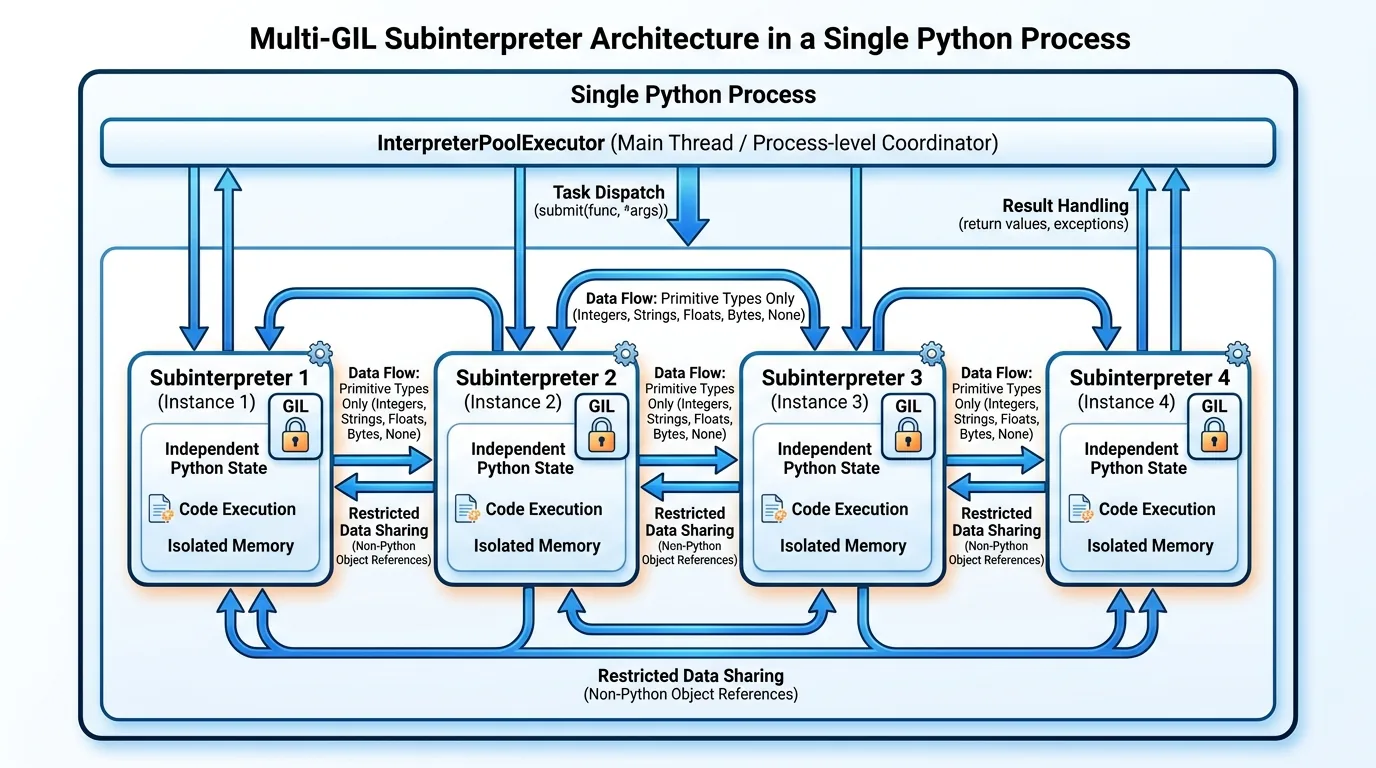
What if you could have multiple Python interpreters inside the same process, each with its own state, but sharing the host process’s address space? That’s exactly what PEP 734 delivers: subinterpreters are now part of the standard library under concurrent.interpreters.
Here’s the deal: you can spin up a new interpreter with its own GIL, its own module namespace, its own everything. They don’t share state automatically — you have to explicitly send data between them (like actors or channels). That isolation means:
- No GIL contention between subinterpreters — each runs independently.
- Safety — a crash in one interpreter doesn’t bring down the whole process (well, mostly).
- Better resource management — you can run multiple workloads inside a single process, avoiding the overhead of full-blown processes.
The new InterpreterPoolExecutor works like ThreadPoolExecutor or ProcessPoolExecutor, but uses subinterpreters underneath. Want to run a batch of CPU-heavy tasks in parallel without worrying about GIL? Just do:
from concurrent.interpreters import InterpreterPoolExecutor

def fibonacci(n):
    # compute the nth Fibonacci number (CPU-intensive)
    ...

with InterpreterPoolExecutor(max_workers=4) as executor:
    results = list(executor.map(fibonacci, range(10, 20)))
Boom. Four parallel interpreters, each hogging its own GIL. You get true parallelism without forking separate processes.
Now, I’ll level with you: this feature has been a long time coming. The _xxsubinterpreters module existed as an experiment since Python 3.12. But 3.14 makes it official, stable, and documented. That means you can build on it with confidence.
Of course, there are caveats. Communication between interpreters is limited — you can pass simple objects like strings, bytes, and ints safely, but complex objects need serialization (think pickle or struct). And you can’t share mutable state unless you use shared memory primitives. This isn’t “free parallelism for all code.” But for workloads that can be farmed out as independent units — data processing pipelines, web request handlers, game AI agents — it’s a dream.
5. Why You Should Care (And What’s Coming Next)
So, what does all this mean for you, the developer who just wants to ship code?
First, update your tooling. If you’re using type checkers like mypy or pyright, they’ll need to understand deferred annotations to give you accurate results. Most already do, but double-check. And if you’re maintaining a library that does runtime annotation inspection (like Pydantic or FastAPI), you’ll want to test against 3.14’s annotationlib module early.
Second, start experimenting with t-strings. Even if you don’t build your own renderer, see if your favorite web framework plans to adopt them. The security benefit alone is worth the migration headache.
Third, consider subinterpreters for any CPU-bound task that currently forces you to use multiprocessing. The reduced overhead and simpler memory model might surprise you.
This is the first in a series covering Python 3.14’s new features. Next time, I’ll dig into the freethreaded mode — what it means to finally have a GIL-less Python, and why you might (or might not) want to flip that switch. Stay tuned.
Until then, happy coding — and may your annotations be ever lazy, your strings ever safe, and your interpreters ever parallel.
References
- PEP 649 – Deferred Evaluation of Annotations using Descriptors: https://peps.python.org/pep-0649/
- PEP 749 – Deferred evaluation of annotations: https://peps.python.org/pep-0749/
- PEP 750 – Template Strings: https://peps.python.org/pep-0750/
- PEP 734 – Multiple Interpreters in the Standard Library: https://peps.python.org/pep-0734/
- Python 3.14 What’s New (official docs): https://docs.python.org/3/whatsnew/3.14.html
- Miguel Grinberg’s Python 3.14 performance benchmarks (blog): https://blog.miguelgrinberg.com/post/python-3-14-performance-testing
- annotationlib module documentation: https://docs.python.org/3/library/annotationlib.html