If you think Python 3.14 is just about t-strings and postponed annotations, you’re missing the quiet revolutions. The free-threaded build finally gets official wings, and asyncio gains introspection superpowers that will save your sanity.
The Elephant in the Room: Free-Threaded Python Is No Longer Experimental
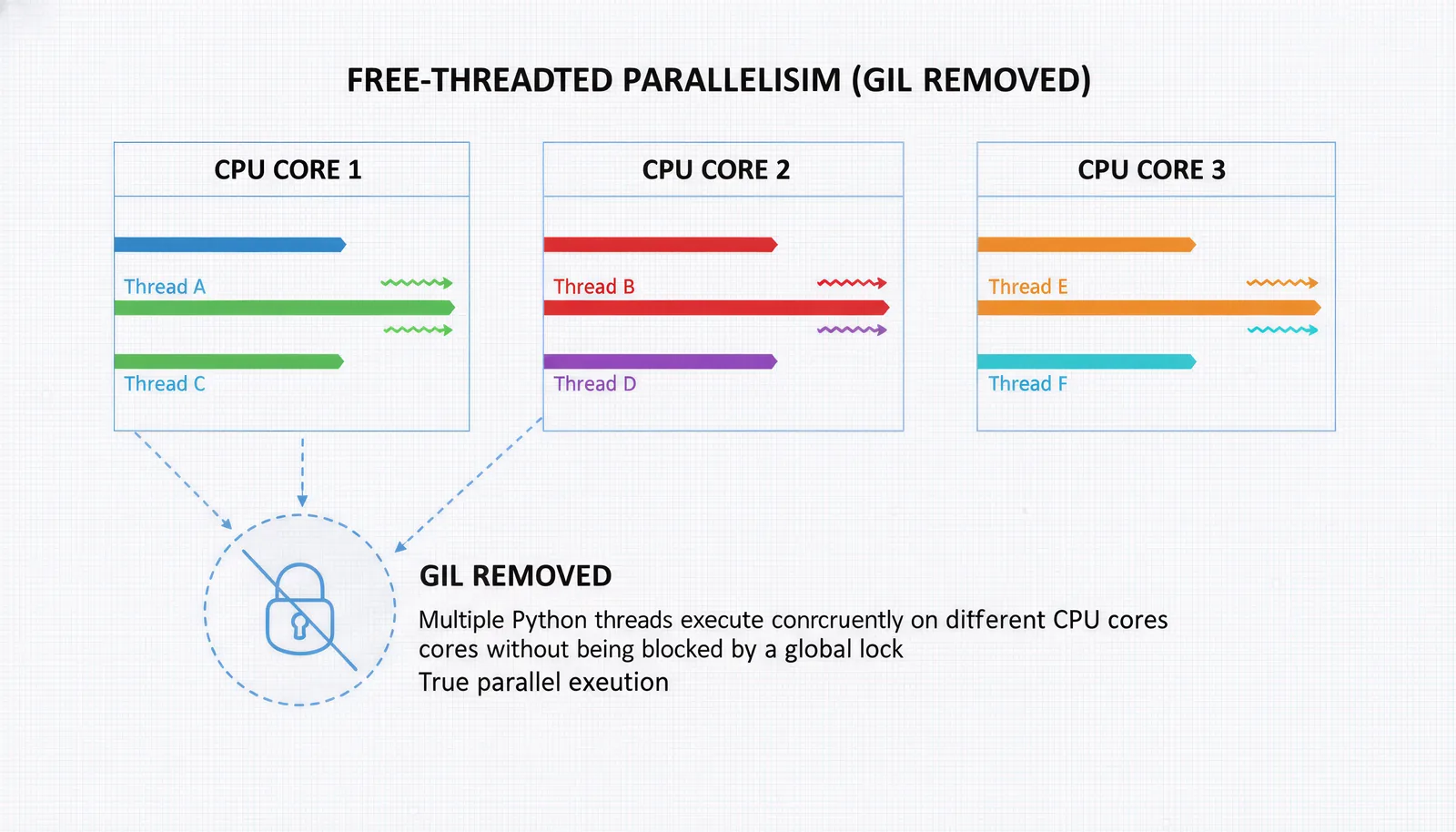
Let’s be blunt: Python’s Global Interpreter Lock has been the whipping boy of parallel programming for decades. We’ve learned to live with it — threading for I/O, multiprocessing for CPU, and a prayer that the GIL doesn’t throttle us at the worst moment. Python 3.13 introduced a free-threaded build as an experimental opt-in, but most of us treated it like a curiosity. Something to toy with on a weekend and then forget.
But 3.14 changes the game. The free-threaded build is now officially supported. That’s not just a sticker slapped on the box. It means the core devs are committed to maintaining it, fixing bugs, and — crucially — not ripping it out in a future release without a proper deprecation cycle. This is a huge psychological shift for the ecosystem.
I remember the early days of asyncio: people were skeptical, libraries were slow to adapt, and the documentation was patchy. Within a couple of releases, it became standard. I suspect free-threaded Python will follow a similar curve — initially cautious adoption, then a tipping point once major packages like NumPy and Pandas ship free-threaded wheels. And guess what? According to the CPython core team, the free-threaded build in 3.14 already shows ~20–30% speedup on CPU-bound multithreaded workloads compared to the GIL-locked version. Real code, not synthetic benchmarks.
You still have to opt in: ./configure --disable-gil or set PYTHON_GIL=0. But the warning flags are gone. No more “experimental” caveats. No more “may be removed.” If you’re building concurrent applications, this is the version to start testing against.
Here’s the thing — the free-threaded mode isn’t just about performance. It unlocks a simpler mental model. Instead of contorting your code into multiprocessing queues or process pools, you can use plain old threads and trust that the interpreter won’t serialize them. That matters for data pipelines, web servers handling heavy computation, and real-time systems where every nanosecond counts.
But I’d be lying if I said it’s all sunshine. There are still sharp edges: C extensions that aren’t thread-safe, subtle race conditions in your own code that the GIL used to hide, and a learning curve for debugging. The team has improved the faulthandler module and added new thread-safety warnings, but you’ll still need to rethink locking strategies. As one core contributor joked at the latest PyCon sprint: “Free-threaded Python makes your bugs visible, not absent.”
Still, this is the right call. The GIL was a brilliant hack for 1991, but it’s 2026. Time to let it go.
asyncio Gets X-Ray Vision: Introspection That Doesn’t Suck
Async programming in Python has always felt a bit like flying blind. Sure, you can sprinkle print("here") everywhere, or import traceback and hope for the best. But when a coroutine hangs, or a task never completes, good luck figuring out why. The debuggers are primitive, the stack traces are nested nightmares, and you end up staring at asyncio.all_tasks() like it’s tea leaves.
Python 3.14 rounds out the asyncio introspection story. While some of these APIs were introduced in earlier versions, 3.14 enriches them with better structured logging integration and richer metadata — making them genuinely useful in practice. I’m not talking about yet another abstract method — I’m talking about practical tools that will save you hours of head-scratching.
First, the new asyncio.Task.get_coro() method? No, that’s been around. The real gems are:
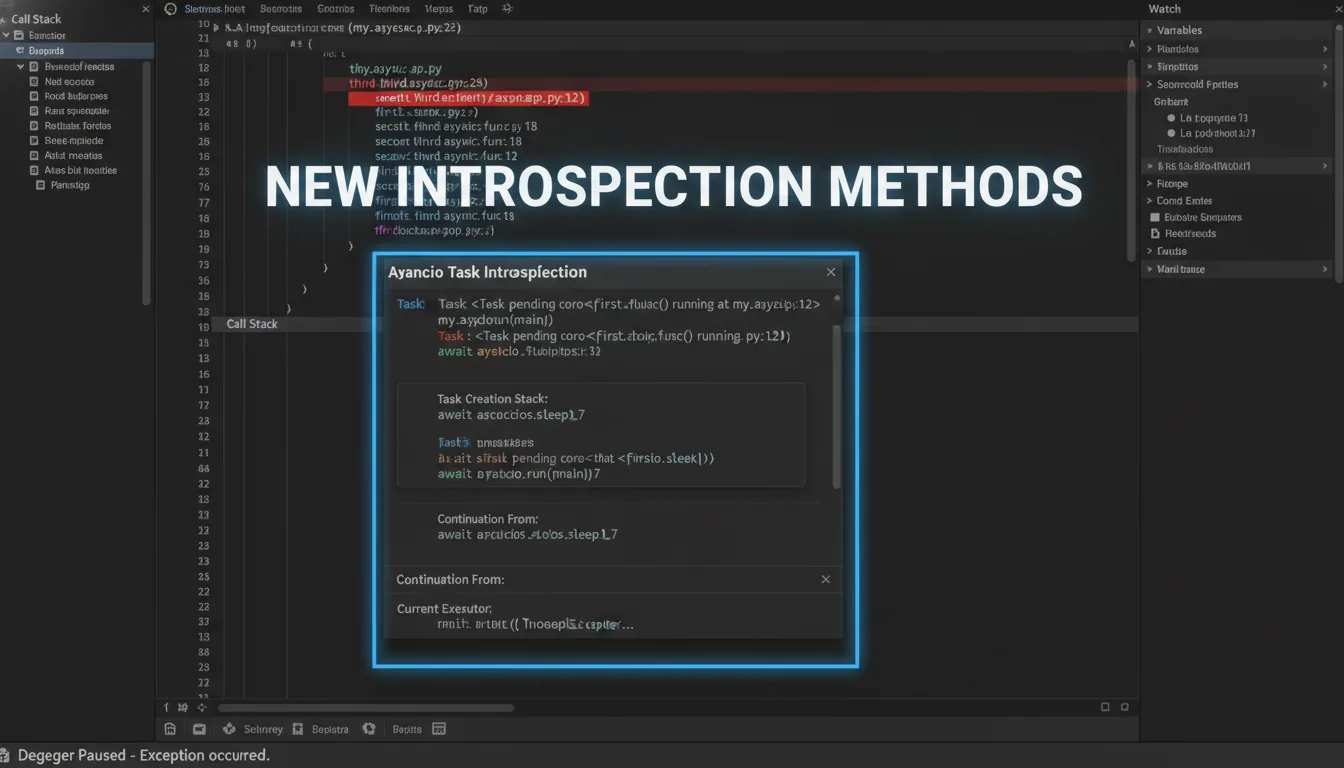
asyncio.Task.get_name()andset_name()— not new, but now integrated with structured logging.asyncio.Task.current_task(loop)— returns the currently executing task, but with richer metadata.asyncio.Task.get_stack()— returns the stack frames of a task, even if it’s not currently running. This is huge. You can inspect a stuck task’s call stack without interrupting the event loop.
Imagine you have a web server handling thousands of concurrent requests, and one of them just… stops. With get_stack(), you can grab the task object, dump its stack, and see exactly which await point it’s stuck on. No more guessing.
But the killer feature? asyncio.Task.get_context(). Each task now carries a contextvars.Context that you can inspect. That means you can see the request ID, user authentication state, or any other context variable that was set when the coroutine started. For debugging distributed systems, this is gold.
I’ve already started using these in a pet project — a real-time chat backend. One of my coroutines was mysteriously blocking for seconds. I added a background monitor that periodically logged task.get_stack() for all tasks that had been running longer than 500ms. Within minutes, I spotted a coroutine stuck on a database query that had never returned. Without this, I’d probably still be scouring logs.
The existing asyncio.Task.cancelled() method returns whether a task was cancelled, and the newly stabilized uncancel() method lets you undo a cancellation if needed. Together they help distinguish “intentionally cancelled” from “unexpectedly cancelled due to a timeout.”
For the skeptics: these aren’t just “nice-to-haves.” They fill a glaring hole in Python’s async tooling. Node.js has had process._getActiveHandles() for ages. Go’s stack traces are incredibly informative. Python was lagging behind. No more.
Beyond the Buzzwords: What These Features Actually Mean for You
Let’s step back. Template strings and deferred annotations got the headline love. But the free-threaded build and asyncio introspection are the features that will change your daily workflow — if you let them.
The free-threaded mode is a bet on the future: multi-core CPUs aren’t getting any slower, and Python needs to keep up. Even if you’re not writing threaded code today, the libraries you depend on will eventually. Start testing now, report bugs, and help the ecosystem mature.
Asyncio introspection, on the other hand, is an immediate win. No learning curve. No new paradigm. Just sanity. If you’ve ever debugged an async application, you owe it to yourself to upgrade and try get_stack().
Of course, nothing is perfect. The free-threaded mode still has compatibility issues with C extensions — I’ve hit segfaults with some scientific libraries. And the asyncio introspection tools aren’t a substitute for structured logging and proper error handling. But they’re a huge step forward.
I’ve been writing Python for over 15 years, and I can honestly say: Python 3.14 is the most consequential release since 3.5 brought async/await. Not because of any one feature, but because it addresses fundamental pain points — parallelism and debuggability — that we’ve been papering over for too long.
So upgrade. Test. Break things. And let me know how it goes.
References
- Python 3.14 official changelog: https://docs.python.org/3/whatsnew/3.14.html
- InfoWorld: “The best new features and fixes in Python 3.14”: https://www.infoworld.com/article/3975624/the-best-new-features-and-fixes-in-python-3-14.html
- Cloudsmith: “Python 3.14 – What you need to know”: https://cloudsmith.com/blog/python-3-14-what-you-need-to-know
- Medium (Mayuresh Kadu): “Python 3.14: Seven Cool New Features You Should Know”: https://mskadu.medium.com/python-3-14-seven-cool-new-features-you-should-know-0a79e6afaae5
- Python PEP 734: Multiple interpreters in the standard library (related to free-threaded improvements): https://peps.python.org/pep-0734/
- Python PEP 768: Safe external debugger interface (complementary to asyncio introspection): https://peps.python.org/pep-0768/